


THE ARCHITECT’S BLUEPRINT : NAVIGATING THE 36 CHAPTERS OF NATYA SHASTRA

In our previous blog, we looked at the "secret" of human emotion—the Navarasas. But where did this wisdom come from? It came from the Natya Shastra, an ancient encyclopedia attributed to Sage Bharata.
If you were to open this 2,000-year-old manuscript today, you wouldn't just find dance steps. You’d find instructions on architecture, lighting, music, grammar, and even how to sit! Below is your roadmap to the 36 "Adhyayas" (Chapters) of the ultimate performance playbook.
The Master Map: 36 Chapters of the Natya Shastra

Phase 1: The Setup & The Space
1. Nāṭyotpatti: The origin story of how and why drama was created as a "Fifth Veda."
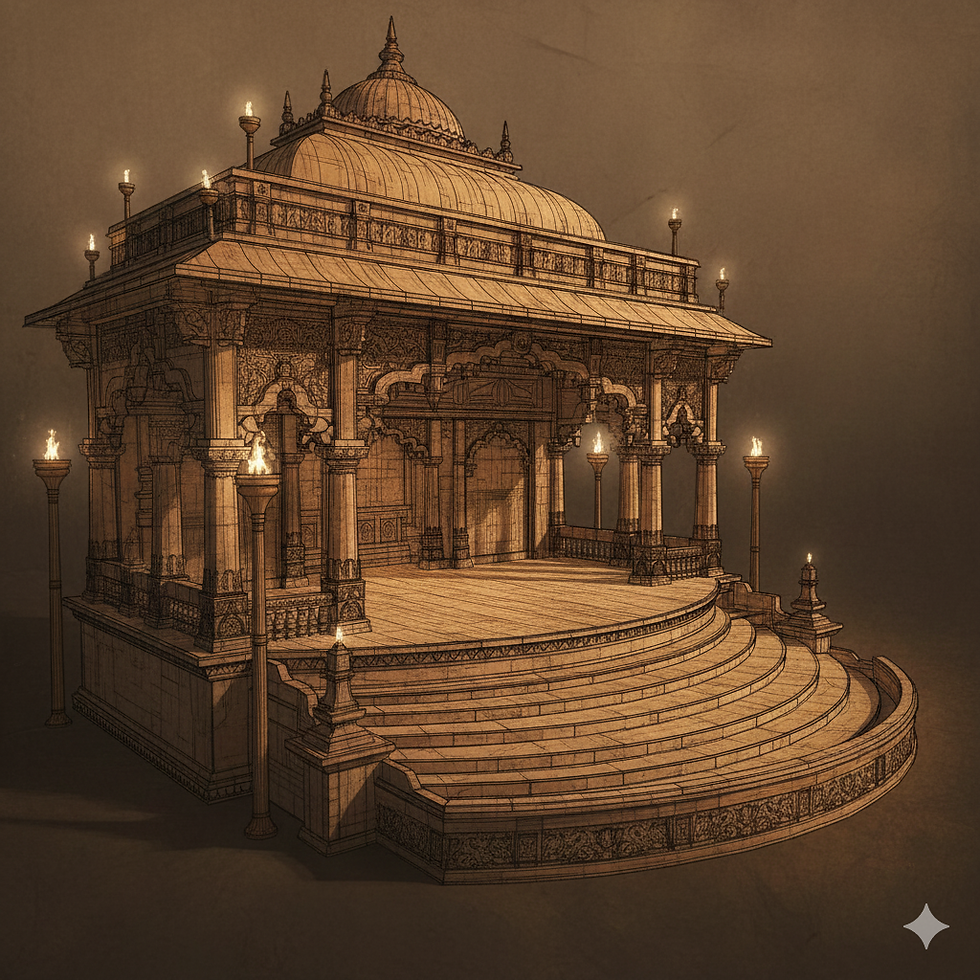
2. Maṇḍapavidhāna: The architectural blueprint for building the perfect theater.
3. Raṅgadaivatapūjana: How to bless and "clear the energy" of the stage before a show.
4. Tāṇḍavalakṣaṇa: The 108 Karanas (basic dance units) that form the foundation of movement.
5. Pūrvaraṅgavidhāna: The "opening act" rituals performed before the main play begins.
Phase 2: The Soul of Art
Rasavikalpa: The famous theory of the 8 (later 9) aesthetic "flavors" or moods.
Bhāvavyañjaka: The psychology of the internal emotions that trigger those moods.
Upāṅgavidhāna: The "micro-movements" of the face—eyes, brows, nose, and cheeks.
Āṅgikabhinaya: The universal language of hand gestures (Mudras) and limb movements.
Śārīrābhinaya: How to move the torso, chest, waist, and hips with precision.
Phase 3: Motion & Logic
Cārīvidhāna: The grammar of leg movements and how to "walk" the dance.
Maṇḍalavikalpa: Complex circular and spatial patterns for moving across the stage.
Gatipracāra: Character-specific "gaits"—how a king walks versus a hunter.
Pravṛttividhāna: The regional styles and the difference between "realistic" and "stylized" acting.
Phase 4: Speech & Storytelling
Vācikābhinaya: The science of speech, including grammar, vowels, and consonants.
Kāvyalakṣaṇa: The "poetic sparkle"—how to use metaphors and ornaments in a script.
Vāgabhinaya: The art of delivery—pitch, tone, and how to address different characters.
Daśarūpavidhāna: The 10 distinct genres of plays, from heroic epics to comedies.
Sandhinirūpaṇa: Plot structure—how to weave a story together from start to finish.
Vṛttivikalpa: The four "acting styles"—Verbal, Grand, Energetic, and Graceful.
Phase 5: Visuals & Evaluation
Āhāryābhinaya: The guide to costumes, jewelry, makeup, and stage props.
Sāmānyābhinaya: How to harmonize all forms of acting into one seamless performance.
Vaiśikopacāra: The nuanced art of portraying romance and courtship on stage.
Sthry-upacāra: Specialized instructions for portraying female characters and their temperaments.
Citrābhinaya: How to use gestures to "paint" things like sunlight, rain, or animals.
Siddhivyañjaka: The "Review System"—how to judge if a performance was a success or failure.

Phase 6: The Sound of the Soul (Music)
Atodyavidhāna: The master classification of all musical instruments.
Tatatodya: The science of stringed instruments (like the Veena) and scales.
Suṣiravidhāna: The logic of wind instruments (like the Flute) and their notes.
Tālavidhāna: The complex mathematics of rhythm and time-cycles (Tala).
Dhruvāvidhāna: The rules for the specific songs sung during a theater production.
Avanaddhavidhāna: The deep science of drums and percussion instruments.
Phase 7: The Human Element
Prakṛtivicāra: Classifying characters into "types" (Superior, Middling, or Inferior).
Bhūmikāvikalpa: The art of casting—choosing the right actor for the right role.
Nāṭyāvatāra: The final history of how this divine art descended from the gods to humans.
Guṇadoṣavicāra: A concluding look at the merits and flaws of a performance.


Comments